
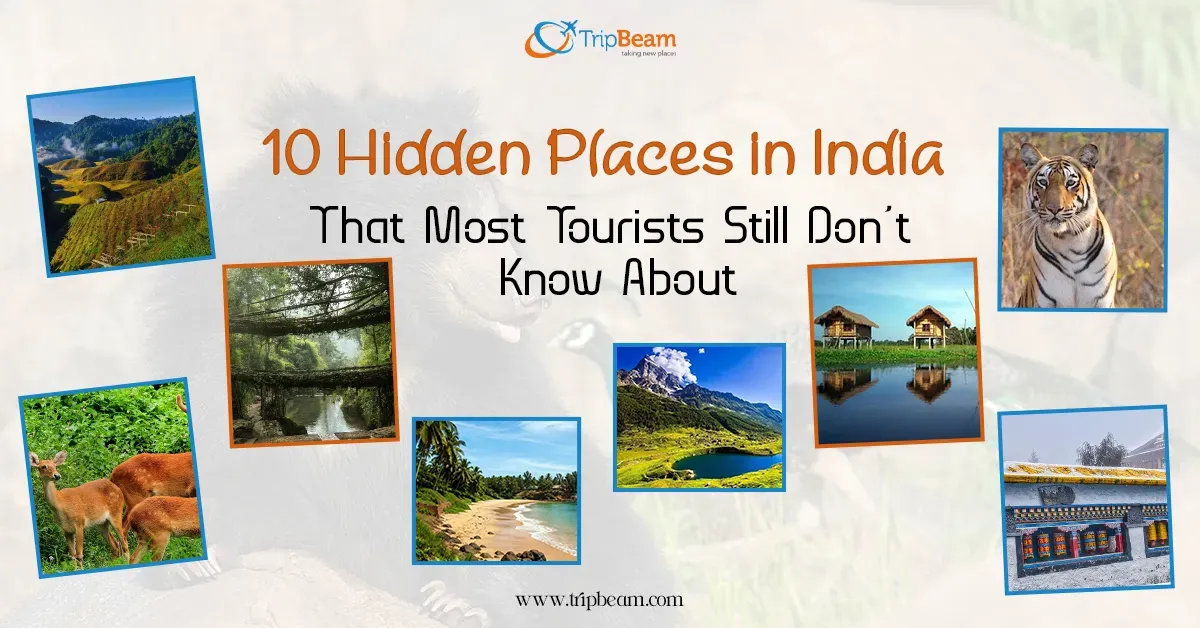
On a trip to India, almost every traveller visits the same tourist places. They see the Taj Mahal, spend a few days in Goa, explore Jaipur’s palaces, and go back to Canada feeling like they have explored India fully.
The reality is that some of India’s hidden places sit far from the usual tourist trail.
There is a national park that floats on a lake. A river island larger than some countries. Bridges grown from living tree roots. Remote valleys where mountains outnumber visitors.
If you’re planning a trip from the U.S. and want to see the hidden places in India that many tourists miss, these places deserve a place on your itinerary.
1. Tawang, Arunachal Pradesh
Tawang sits so far east that most visitors never make the journey. That is the only reason it still feels untouched or hidden.
Perched in the Eastern Himalayas near the borders of Tibet and Bhutan, Tawang combines dramatic mountain scenery with a deep Buddhist heritage. The town has Tawang Monastery, the largest monastery in India and one of the most important Buddhist sites outside Tibet.
It is a long journey but that is part of what keeps the crowds away. You arrive and find snow on the peaks, clear mountain lakes, and a rhythm of life that has not changed much in decades.
Getting there: Fly to Guwahati and drive 12 to 14 hours north through the Arunachal Pradesh mountains. Sometimes, travellers split it into two days with a stop in Bomdila.
2. Ziro Valley, Arunachal Pradesh
Some destinations impress you immediately. Ziro Valley reveals itself slowly.
Rice fields cover the valley floor and pine forests rise behind them. Apatani villages sit in between, unchanged by most of what happens elsewhere in India.
There are no famous temples or monuments here — nothing to rush through. The point is simply being there for a few days and letting the pace of the place settle into you.
The Apatani people have lived here for centuries with their own way of doing things: agriculture, architecture, everything distinct. The valley has not been packaged for tourism and it shows. That is what makes it worth the journey.
Getting there: Book a flight to Guwahati or Dibrugarh and drive into Arunachal Pradesh. The roads are long but the valley is quiet enough to justify it.
3. Living Root Bridges, Meghalaya
You have seen bridges being built. These are grown.
Hidden within Meghalaya’s rainforests, the Living Root Bridges are created by guiding the roots of rubber trees across streams and rivers. The process takes decades, sometimes generations.
What makes them remarkable is that they get stronger as they age. More roots intertwine, the structure solidifies, and what was once a guide becomes an actual bridge. Walking across one does not feel like crossing a bridge. It feels like the forest itself has agreed to let you through.
Getting there: Take a flight to Guwahati and drive south into Meghalaya (4-5 hours). The main living root bridges are near Cherrapunji and Mawlynnong.
4. Keibul Lamjao National Park, Manipur
You have seen many national parks all over the world but you have never seen one that floats.
Keibul Lamjao National Park sits on Loktak Lake and is made up of floating masses of vegetation known as phumdis. The park is also the last natural habitat of the endangered Sangai deer, often called the dancing deer because of the way it moves across the floating landscape.
The park is fragile. Tourism is limited. Getting there requires planning and respect for what makes the place work. It’s one of those places that sounds impossible until you see it for yourself.
Getting there: Fly to Imphal and then drive to Loktak Lake (about 1.5 hours). Entry to the park is by boat only so hire a licensed operator.
5. Majuli, Assam
Life moves differently on Majuli.
Located in the Brahmaputra River, Majuli is the world’s largest inhabited river island and a place where centuries-old traditions remain part of daily life.
Monasteries or satras play a central role in the island’s culture. Add quiet roads, open countryside, and river views in every direction, and it’s easy to understand why travellers often stay longer than planned.
Getting there: Fly to Guwahati and drive south to Jorhat (5 to 6 hours). From Jorhat, take a ferry across the Brahmaputra to Majuli (30 minutes to 1 hour depending on the crossing point).
6. Tadoba National Park, Maharashtra
When people talk about tiger safaris in India, Ranthambore gets the attention. Tadoba deserves more of it.
The reserve has one of the healthiest tiger populations in the country and often delivers excellent wildlife sightings without the heavy tourist traffic found elsewhere in India. For wildlife enthusiasts, that’s a combination worth seeking out.
Getting there: Fly to Nagpur (closest airport, 3-4 hours from major Indian cities). From Nagpur, drive south to Tadoba (2.5-3 hours). The park has several lodges and resorts nearby.
7. Daroji Sloth Bear Sanctuary, Karnataka
Most visitors come to Hampi for its ancient ruins. Few realize one of India’s most unusual wildlife experiences is just a short drive away.
Daroji Sloth Bear Sanctuary protects one of the country’s largest populations of sloth bears. Watching these shy animals emerge among the rocky hills during the evening is an experience few travellers expect to have in southern India.
Getting there: Hampi is the nearest major destination (about 1.5 hours away by road). From Hampi, drive to Daroji village and arrange a guide through the sanctuary office. Entry requires a permit; local guides handle this.
8. Bhogwe Beach, Maharashtra
Many travelers head to Goa looking for quiet beaches and leave wondering where all the crowds came from.
Bhogwe Beach offers the version of coastal India that Goa had decades ago. The shoreline is clean, the pace is slow, and fishing boats still outnumber beach clubs.
If your ideal beach holiday involves sunsets, long walks, and uninterrupted views of the Arabian Sea, Bhogwe delivers.
Getting there: Book flights to Mumbai and then drive south along the coast (4-5 hours depending on traffic and which route you take). Bhogwe is in Sindhudurg district, near the town of Malwan. From Malwan, it is a short drive to the village.
9. Gurez Valley, Kashmir
Some places feel remote on a map. Gurez Valley feels remote even when you’re standing in it.
Located near the Line of Control in northern Kashmir, the valley is surrounded by towering mountains, alpine meadows, and traditional wooden villages.
The scenery rivals some of the world’s most famous mountain destinations, yet visitor numbers remain surprisingly low.
Getting there: Fly to Srinagar and drive north toward Gurez (approximately 4-5 hours depending on road conditions and security checkpoints). The road passes through military-controlled areas.
10. Mechuka, Arunachal Pradesh
If you’re looking for a destination that still feels undiscovered, Mechuka is about as close as it gets.
Surrounded by mountains and crossed by the Siyom River, this remote valley offers dramatic scenery and a culture shaped by its isolation.
The road to get here isn’t short, but that’s part of the reason the experience feels so rewarding.
Getting there: Fly to Guwahati and drive east to Arunachal Pradesh (8-10 hours). The final stretch to Mechuka involves a steep mountain road with hairpin turns, not for anxious drivers. The road is narrow and can be damaged by heavy rains.
Final Thoughts
India’s most memorable experiences are not always found in its most famous destinations.
Places like Tawang, Majuli, Mechuka, and Gurez Valley remind travelers that there is still plenty left to explore beyond the standard tourist circuit.
If you’re willing to venture a little farther, you’ll find landscapes, cultures, and experiences that many visitors never see. And those coming from USA can book cheap air tickets to India on Tripbeam.